The Abandoned and The Condemned
On December 5, 1872, the Mary Celeste, a Canadian-built, American-owned merchant ship, was speeding across the Atlantic from the Azores Islands towards Gibraltar with sails at full mast.
However, when it was sighted 1,000 km off the coast of Portugal by the crew of the Dei Gratia, a Canadian brigantine, they discovered that the Mary Celeste was abandoned, completely unmanned. Although the weather was fine and there was no damage to the ship, nor any distress flags, when Oliver Deveau, Chief Mate of the Dei Gratia, boarded the Mary Celeste. On board, he discovered something even more bizarre. All of the ship's papers were missing, except for the captain's logbook. The ship's clock was not functioning, and the compass was destroyed; the sextant and marine chronometer were missing. A six-month supply of uncontaminated food and fresh water remained aboard, and the crew's personal possessions and artifacts were left untouched, making a pirate raid seem extremely unlikely. It appeared the vessel had been abandoned in a hurry. There was no sign of a struggle or of any sort of violence.
I find this one of the more mysterious and intriguing stories related to Portugal's maritime history, and the unusual circumstances have given rise to all kinds of explanations for the ship's abandonment, ranging from alien abduction to mutiny and a variety of hoaxes. Even Conan Doyle presented a theory on what had happened in a popular magazine article.
Today, the coast and interior of Portugal offer similar sights that intrigue me, such as the story of the Mary Celeste. The vast number of abandoned estates, homes, and buildings throughout Portugal offers a starting point for exploration into our past and present, where many mysteries unfold in the emptiness of these decaying spaces.
In the capital, Lisbon alone, there are over 6,000 condemned properties, according to the city's Superintendent. Buildings in populated areas of Porto, the Algarve, and even in remote areas are being condemned faster than they are restored, a growing trend across Europe as the financial crisis compounds the challenge of maintaining our heritage. Large numbers of citizens are moving to city-suburbs for work or immigrating to other countries for greater opportunities and new beginnings.
The politics and economics behind this growing trend are complex, and with over 11 million abandoned or vacant homes in Europe right now, there are more than double the number of homes for every homeless person in Europe. Why are prices not dropping in a stagnant economic crisis where a supply of abandoned homes on the market far exceeds the demand? This question leads to as many explanations as there are for the mysterious abandonment of the Mary Celeste.
Below are some of my favorite places abandoned or condemned around Portugal today. In their sad state of decay, I hope for their rehabilitation before it is too late to save them, and at the same time I enjoy the beauty they possess, expressing our impermanence and struggle to remain present.

_________________________________________________________________________

The Castelo da Dona Chica, located in Braga, is a beautiful, ornate Gothic-inspired castle built by Frances Peixoto de Sousa in 1915. The works dragged on for decades, and costs became so out of control that the owners abandoned the mansion.
http://en.wikipedia.org/wiki/Castle_of_D._Chica
_________________________________________________________________________

Casa do Professor ou Quinta do Parreira, (The teacher's house or Estate of Grape leaves). A beautiful House, which had several owners over the years. The names by which it is known due to two of its owners. Its first owner was a man named Doc Ab, a well-known, wealthy landowner in the region who aided the most needy peasants in the countryside, even providing them employment on other properties he owned.
However, when it was sighted 1,000 km off the coast of Portugal by the crew of the Dei Gratia, a Canadian brigantine, they discovered that the Mary Celeste was abandoned, completely unmanned. Although the weather was fine and there was no damage to the ship, nor any distress flags, when Oliver Deveau, Chief Mate of the Dei Gratia, boarded the Mary Celeste. On board, he discovered something even more bizarre. All of the ship's papers were missing, except for the captain's logbook. The ship's clock was not functioning, and the compass was destroyed; the sextant and marine chronometer were missing. A six-month supply of uncontaminated food and fresh water remained aboard, and the crew's personal possessions and artifacts were left untouched, making a pirate raid seem extremely unlikely. It appeared the vessel had been abandoned in a hurry. There was no sign of a struggle or of any sort of violence.
I find this one of the more mysterious and intriguing stories related to Portugal's maritime history, and the unusual circumstances have given rise to all kinds of explanations for the ship's abandonment, ranging from alien abduction to mutiny and a variety of hoaxes. Even Conan Doyle presented a theory on what had happened in a popular magazine article.
Today, the coast and interior of Portugal offer similar sights that intrigue me, such as the story of the Mary Celeste. The vast number of abandoned estates, homes, and buildings throughout Portugal offers a starting point for exploration into our past and present, where many mysteries unfold in the emptiness of these decaying spaces.
In the capital, Lisbon alone, there are over 6,000 condemned properties, according to the city's Superintendent. Buildings in populated areas of Porto, the Algarve, and even in remote areas are being condemned faster than they are restored, a growing trend across Europe as the financial crisis compounds the challenge of maintaining our heritage. Large numbers of citizens are moving to city-suburbs for work or immigrating to other countries for greater opportunities and new beginnings.
The politics and economics behind this growing trend are complex, and with over 11 million abandoned or vacant homes in Europe right now, there are more than double the number of homes for every homeless person in Europe. Why are prices not dropping in a stagnant economic crisis where a supply of abandoned homes on the market far exceeds the demand? This question leads to as many explanations as there are for the mysterious abandonment of the Mary Celeste.
Below are some of my favorite places abandoned or condemned around Portugal today. In their sad state of decay, I hope for their rehabilitation before it is too late to save them, and at the same time I enjoy the beauty they possess, expressing our impermanence and struggle to remain present.
Hotel da Foz da Sertã, located in the region of Cernache do Bonjardimon, on the banks of the Albufeira of Castelo do Bode, near the bridge of Vale da Ursa, stands a four-story hotel with 44 rooms and several apartments. After the Carnation Revolution on April 25, 1974, the place was abandoned following an agreement to use it as accommodation for returnees from Portugal's former colonies. Afterward, the hotel began to fall into such a state of disrepair that the owner was driven to suicide.
_________________________________________________________________________
The Sanatório do Caramulo, located in Tondela, is one of the 19 sanitariums in Caramulo. A resort created in 1921 was the first town in Portugal to have sanitation and electricity. The vision of Dr. Jerónimo de Lacerda was to create a healing environment for treating patients with tuberculosis.
_________________________________________________________________________
Palácio do Rei do lixo ou Torre do Inferno (The Palace of the King of Trash, or Towering Inferno), located in Coina. This strange tower has become an unofficial landmark of the region. Built by Manuel Martins Gomes Júnior, known as "The King of the Trash," in order to show his greatness. Some say he built the Palace so that he could see the property he owned in Alcácer do Sal.
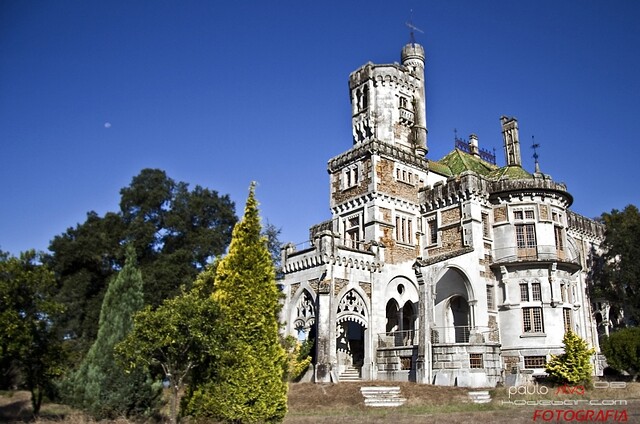
The Castelo da Dona Chica, located in Braga, is a beautiful, ornate Gothic-inspired castle built by Frances Peixoto de Sousa in 1915. The works dragged on for decades, and costs became so out of control that the owners abandoned the mansion.
http://en.wikipedia.org/wiki/Castle_of_D._Chica
_________________________________________________________________________
Casa do Professor ou Quinta do Parreira, (The teacher's house or Estate of Grape leaves). A beautiful House, which had several owners over the years. The names by which it is known due to two of its owners. Its first owner was a man named Doc Ab, a well-known, wealthy landowner in the region who aided the most needy peasants in the countryside, even providing them employment on other properties he owned.


Comments
Post a Comment